

Inflammatory diseases of the skin and subcutaneous tissue
An abscess is a collection of pus in various tissues and organs, delimited by a pyogenic membrane.
Phlegmon is a diffuse purulent inflammation of tissue. Phlegmon can develop in any part of the body, during a violent course — cover several anatomical areas.
Topical diagnosis of odontogenic phlegmons of the maxillofacial region is based on 4 local signs:
I. Sign of the “causal tooth”. In the oral cavity, there is a periodontitis or periodontitis tooth, the periodontium of which is the “generator” of the infection, which spreads and affects the soft tissues adjacent to it. It is revealed on the basis of the patient’s complaints, examination and radiography.
II. A sign of severity of inflammatory infiltrate of soft tissues. It is sharply expressed in superficial phlegmons and absent or weakly detected in deep ones. In this case, visible manifestations of infiltration are evaluated and, as a criterion for its violation, the configuration of the face or the absence of asymmetry.
III. A sign of impaired motor function of the lower jaw. It is known that any inflammatory process localized in the area of at least one of the masticatory muscles to one degree or another disrupts the motor function of the lower jaw.
IV. A sign of difficulty swallowing. It occurs when the inflammatory infiltrate is localized in the area of the muscles of the side wall of the pharynx, while as a result of compression or muscle contracture pain occurs when swallowing.
A furuncle is a purulent-necrotic inflammation of a hair follicle and its surrounding tissues.
As the process progresses, the inflammation spreads to the sebaceous gland and surrounding tissues, including nearby hair follicles, which leads to the formation of a carbuncle — a draining purulent-necrotic inflammation of several hair follicles and sebaceous glands with the formation of a general large necrosis of the skin and subcutaneous tissue.
With untimely treatment or self-treatment (squeezing) of boils and carbuncles in the areas of the upper lip, nasolabial fold, nose, suborbital area, the development of a severe condition is possible, accompanied by progressive thrombophlebitis and the transition to the venous sinuses, dura mater, which, in turn, leads to such serious diseases as basal meningitis and sepsis, etc.
Treatment of inflammatory diseases of the skin and subcutaneous tissue – dissection of the purulent focus taking into account the direction of the facial nerve and ensuring the outflow of pus from the purulent focus, washing (dialysis) of the purulent center and its drainage, aseptic gauze bandage with a hypertonic solution over the purulent wound, removal of the “causative” tooth according to indications.
Inflammatory diseases of the oral cavity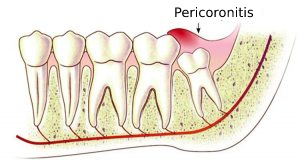
Pericoronitis is accompanied by inflammation of the tissues around the erupting tooth. With severe and long-term teething, a kind of hood is formed over the tooth,
under which disease-causing bacteria and food residues fall. As a result, an inflammatory process develops.
Treatment of pericoronaritis is almost always surgical. In the case of tissue inflammation around the molars and premolars, dentists choose the tactic of excision of the gum hood. But treatment in the area of eighth teeth is almost always performed by removing wisdom teeth.
Periostitis or, as this disease is often called in the people – flux – is an inflammation of the periosteum, which occurs first on its surface, and then penetrates into other layers. The periosteum in the form of soft connective tissue covers the entire surface of the bone with a thin film. It serves as a connecting link between the tooth and all the muscles surrounding it, and also performs a protective function for the bone. The first sign of periostitis is a slight swelling of the gums, which is accompanied by pain.

Periostitis is a serious disease that requires immediate medical attention. The effectiveness of the treatment of the disease depends on the stage at which it is started. At the beginning of the development of the disease, when a purulent abscess has not yet formed, it is enough to open the cavity of the affected tooth and clean the canal of serous exudate.
If the disease has turned into a purulent form, surgical intervention with dissection of the periosteum in the area of inflammation is necessary. Local anesthesia is used for pain relief.

Osteomyelitis of the jaw is a purulent, infectious-inflammatory process that captures all structural components of the jaw bone and leads to osteonecrosis.
Osteomyelitis of the jaw is accompanied by general symptoms, such as weakness, fever, chills, and local symptoms: pain, restriction of mouth opening, tooth mobility, inflammatory infiltration of soft facial tissues, formation of fistulas, sequestrations, abscesses, etc.
Most often, the disease is diagnosed on the lower jaw, as the teeth of the lower row are more prone to caries and various traumatic effects.
The risk of developing osteomyelitis increases in the presence of an immunodeficient state, as well as diseases of the circulatory system. This is due to the fact that the wounds of a person with such pathologies do not heal well, and the body is not able to resist infections.
Other factors provoking the disease include:
• smoking;
• alcohol abuse;
• diabetes;
• starvation or poor nutrition;
• syphilis;
•courses of chemotherapy and radiation therapy.
If the acute development of the disease is not cured to the end, chronic osteomyelitis of the jaw develops. It is more difficult to respond to conservative therapy, and also more often leads to complications.
Phasing of our work
1. Consultation
You can make an appointment with a doctor by phone number or visit the trauma center of the hospital on a first-come, first-served basis.
2. Drawing up an individual treatment plan
The doctor develops an optimal treatment plan based on the examination and the medical history.
3. Outpatient admission or hospitalization
Depending on the severity of each individual case, the doctor may recommend inpatient or outpatient treatment.
4. Recommendations
At the end of the treatment, the doctor gives instructions and, if necessary, appoints dispensary supervision.
Patients per year
outpatient operations annually
inpatient operations annually
years of experience


